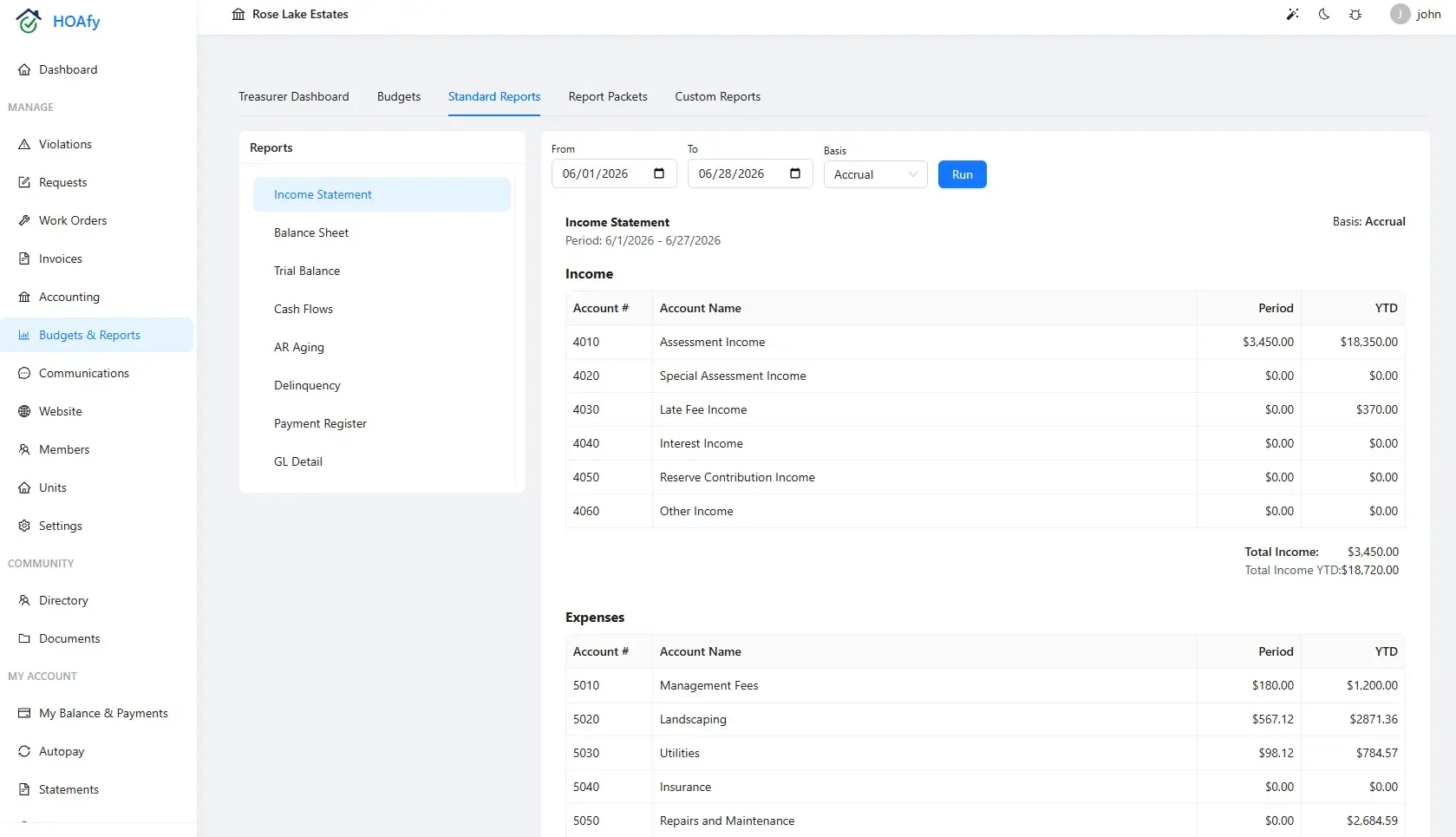
HOA accounting, Accrual accounting, HOA financial statements, HOA board, Self-managed HOA, Financial, Board Tips
Team HOAfy
The Short Answer
The three methods commonly discussed for HOA accounting are cash basis, accrual basis, and modified accrual (also called modified cash in some settings). The method determines when assessments and expenses are recognized and which assets and liabilities appear on the balance sheet.
- Cash basis recognizes activity when cash changes hands. It is simple but can hide unpaid assessments and vendor bills.
- Accrual basis recognizes revenue when earned and expenses when incurred. It gives the board the most complete financial picture and is the basis used for U.S. GAAP financial statements.
- Modified accrual combines selected elements of cash and accrual accounting. It can improve interim reporting, but the exact policy must be defined because the term is not used consistently everywhere.
For most established associations, accrual-basis financial statements are the strongest default for board oversight. The final choice must account for state law, governing documents, tax reporting, lender requirements, and the association's CPA.
Important: This article provides general education, not accounting, tax, or legal advice. “Modified accrual” can have a different technical meaning in governmental accounting. An HOA should document exactly how it uses the term.
What “Basis of Accounting” Means
The basis of accounting is the rule for timing transactions. It answers questions such as:
- Is assessment income recorded when owners are charged or when they pay?
- Is a landscaping expense recorded when service is received or when the check clears?
- Does the balance sheet show owner receivables and unpaid vendor bills?
- How are assessments paid before their due date reported?
The method does not change the underlying event. The association still billed an owner, received landscaping service, or paid a vendor. It changes when those events appear in the statements and how much context the board can see.
One Month, Three Different Pictures
Consider a fictional 100-home association in April:
- It charges $30,000 in April assessments.
- It collects $27,000 by April 30; $3,000 remains unpaid.
- It receives $1,200 in May assessments paid early.
- A landscaper completes $4,800 of April work but will be paid in May.
- The association pays $1,500 in April for March plumbing work.
The bank account reflects cash movement. The accounting method determines the April income statement and balance sheet.
Cash-Basis April
Cash-basis revenue generally includes the $27,000 collected for April plus the $1,200 received early, subject to the association's policy. The $3,000 still owed does not appear as Assessments Receivable. The $4,800 landscaping obligation does not appear until paid. The $1,500 plumbing payment appears as an April expense even though the work occurred in March.
The report is easy to connect to the bank, but April's apparent result mixes activity from three service periods.
Accrual-Basis April
Accrual-basis accounting recognizes the $30,000 of April assessments as April revenue. It reports the unpaid $3,000 as Assessments Receivable and the early $1,200 as Prepaid Assessments, a liability until May.
It also records the $4,800 landscaping expense in April with an Accounts Payable liability. Paying the March plumbing bill clears an existing payable and does not create a second April expense.
April performance now reflects April economic activity, while the balance sheet shows amounts still to be collected or paid.
Modified-Accrual April
One common HOA policy recognizes assessment revenue when earned, like accrual accounting, but recognizes expenses when paid, like cash accounting. Under that version, April reports $30,000 of assessment revenue and a $3,000 receivable, but the $4,800 unpaid landscaping bill does not appear as an April expense or liability. The $1,500 plumbing payment becomes April expense.
Another organization may use “modified accrual” differently. That ambiguity is why the board must put the policy in writing rather than relying on the label alone.
Side-by-Side Comparison
| Question | Cash basis | Accrual basis | Common HOA modified accrual |
|---|---|---|---|
| Assessment revenue recorded | When received | When earned or charged | Often when earned |
| Owner balances shown as receivable | Usually no | Yes | Often yes |
| Early owner payments shown as liability | Usually no | Yes | Often yes |
| Expense recorded | When paid | When incurred | Often when paid |
| Unpaid vendor bills shown as payable | Usually no | Yes | Often no |
| Matches period activity to budget | Weakest | Strongest | Partial |
| U.S. GAAP basis | No | Yes | No, unless adjusted to full accrual |
| Complexity | Lowest | Highest | Middle |
This table describes common practice, not a universal legal rule. The association's written policy and actual entries control.
Method 1: Cash-Basis HOA Accounting
Cash basis records receipts and disbursements when money moves. A homeowner payment increases revenue when deposited. A vendor cost becomes expense when paid.
Advantages
- Easier for a volunteer treasurer to understand
- Closely follows bank activity
- Requires fewer period-end accrual entries
- Can be workable for a very small association with simple transactions
Limitations
- Omits Assessments Receivable from the balance sheet
- Omits Accounts Payable and other incurred obligations
- Can treat advance payments as current revenue
- Can shift expenses between months based only on payment timing
- Makes actual-to-budget comparison less reliable when the budget uses accrual assumptions
- Can make cash look available even when approved bills are waiting to be paid
Cash basis is not the same as bank reconciliation. Every method still requires the general ledger to be reconciled with the bank statement.
Method 2: Accrual-Basis HOA Accounting
Accrual accounting recognizes revenue when earned and expenses when incurred, regardless of payment timing.
When an assessment becomes due:
| Account | Debit | Credit |
|---|---|---|
| Assessments Receivable | $300 | |
| Assessment Income | $300 |
When a vendor completes approved work and submits a measurable bill:
| Account | Debit | Credit |
|---|---|---|
| Repairs and maintenance | $2,000 | |
| Accounts Payable | $2,000 |
Later cash receipts and payments settle those balance-sheet accounts rather than creating revenue or expense again.
Advantages
- Shows unpaid owner assessments
- Shows approved and incurred vendor obligations
- Distinguishes prepaid assessments from earned revenue
- Matches revenue and expenses with the periods they belong to
- Supports meaningful budget comparisons
- Produces a more complete balance sheet
- Aligns interim reports with accrual-basis year-end financial statements
Limitations
- Requires disciplined billing, Accounts Payable, and closing procedures
- Needs adjusting entries for accruals, prepayments, and other timing items
- Reported surplus does not necessarily equal available cash
- Demands stronger training and review than a checkbook-style system
Accrual reporting does not make cash less important. It makes cash one part of the financial picture. The board should still review cash flows, bank reconciliations, and near-term obligations.
Method 3: Modified Accrual or Modified Cash
In HOA practice, modified accrual often means recognizing assessment revenue when earned while recognizing expenses when paid. This lets the board track owner receivables without maintaining full Accounts Payable. Some associations use other combinations.
Advantages
- More visibility into owner balances than pure cash basis
- Less period-end work than full accrual
- Can serve as an interim operating method when clearly defined and legally permitted
Limitations
- Unpaid vendor bills may be absent from the balance sheet
- Expense timing may not match the budget period
- The label can mean different things to different bookkeepers and CPAs
- Year-end statements may require conversion entries
- Reports are not in conformity with U.S. GAAP unless adjusted to full accrual
If an association uses modified accrual, the policy should explicitly state how it treats assessments, prepayments, late fees, bad debts, vendor invoices, payroll, insurance, taxes, loans, reserve activity, and year-end adjustments.
How the Method Changes HOA Financial Statements
The basis affects more than the income statement. It changes how board members interpret the entire monthly packet.
Balance Sheet
The balance sheet reports assets, liabilities, and fund balance at a specific date:
Assets = Liabilities + Fund Balance
Under accrual accounting, assets commonly include Assessments Receivable and prepaid expenses. Liabilities commonly include Accounts Payable, prepaid assessments, payroll obligations, and accrued costs. Cash basis may omit most of those timing accounts, making the statement shorter but less complete.
Income Statement
The income statement reports revenue and expenses for a period. Accrual basis aligns activity with when it was earned or incurred. Cash basis aligns activity with receipts and payments. If the budget and actual report use different methods, variances can be artifacts of timing rather than operational performance.
Statement of Cash Flows
The statement of cash flows explains why cash changed. It is particularly valuable with accrual statements because net income and cash movement differ. Assessment revenue may be earned before collection, and an expense may be incurred before payment.
Accounts-Receivable Aging
The AR aging lists owner balances by age, such as current, 31–60, 61–90, and more than 90 days past due. Under full accrual accounting, its total should agree with the Assessments Receivable control account on the balance sheet.
Accounts Payable Aging
The AP aging lists unpaid vendor obligations and due dates. Under accrual accounting, its total should agree with Accounts Payable on the balance sheet. Cash-basis records may maintain an unpaid-bills list outside the financial statements, but the board cannot assume it is represented in reported cash-basis expenses.
General Ledger and Check Register
The general ledger contains the entries behind every report. The check or payment register lists disbursements. These are supporting schedules, not substitutes for reconciled financial statements.
Read the board guide to six essential HOA financial reports for review questions and warning signs.
Which HOA Accounting Method Should Your Board Choose?
Use a documented decision process:
- Check state requirements. Some jurisdictions prescribe a basis for budgets, interim records, disclosures, or year-end reporting.
- Read the governing documents. Bylaws, declarations, policies, loan agreements, and management contracts may impose reporting requirements.
- Ask the CPA what year-end statements require. If year-end work is accrual-based, monthly accrual records reduce conversion effort and surprises.
- Match the budget and actual reports. Comparisons are most useful when both use the same basis.
- Assess complexity. Delinquencies, prepaid assessments, loans, payroll, many vendors, and major reserve projects all increase the value of accrual accounting.
- Evaluate controls and software. The board needs a process that can maintain receivables, payables, funds, reconciliations, and locked periods reliably.
- Adopt the policy formally. Record the decision, effective date, responsibilities, and treatment of transition adjustments.
Accrual is usually the most decision-useful choice, but software alone cannot make the books accrual-based. Vendor bills, owner charges, prepayments, and adjusting entries must actually be recorded in the correct period.
How to Move From Cash to Accrual Accounting
Do not change the method by simply checking a report filter. Plan a controlled conversion with the association's accountant.
Typical steps include:
- Select a conversion date, preferably at the start of a fiscal year or clean reporting period.
- Reconcile every bank and investment account.
- Build and verify the owner receivable detail.
- List unpaid vendor bills and accrued obligations.
- Identify assessments and other amounts received in advance.
- Review prepaid insurance and other prepaid expenses.
- Confirm loans, deposits, payroll items, and inter-fund balances.
- Post CPA-approved opening adjustments.
- Verify that subsidiary schedules agree with balance-sheet control accounts.
- Run parallel or comparative reports and explain the changed opening position to the board.
A change in book reporting can also have tax-method implications. The IRS Instructions for Form 1120-H state that taxable income must use a permissible method that clearly reflects income and that changing a tax accounting method may require IRS consent. The board should not assume that changing internal financial reports automatically changes the tax method, or vice versa.
A Monthly Board Review Under Any Method
Whatever basis is selected, the board should receive consistent reports and ask:
- Are all bank accounts reconciled through the statement date?
- Which assessment balances are past due, and how old are they?
- Which vendor obligations are unpaid, including items not shown on cash-basis statements?
- Are operating and reserve cash and activity separated?
- Do actual results use the same basis as the budget?
- Which material variances reflect timing, and which reflect a real change?
- Were prepayments, transfers, reversals, and adjustments classified correctly?
- Can unusual transactions be traced to an invoice, approval, and ledger entry?
The method should improve decision-making, not provide a reason to ignore missing information.
FAQ: HOA Accounting Methods
Is cash or accrual accounting better for an HOA?
Accrual accounting usually gives the board a more complete and comparable view because it includes receivables, payables, and prepayments. Cash basis is simpler but can hide obligations and distort period results. Legal and governing-document requirements may determine or narrow the choice.
Is modified accrual accounting GAAP for an HOA?
Not generally. U.S. GAAP financial statements use accrual accounting. An HOA may use a modified method for interim books where permitted, then post adjustments for year-end accrual statements. Ask the CPA to define the policy and required conversion entries.
Can an HOA keep cash-basis books and receive accrual financial statements?
Yes, if sufficient records exist for the accountant to identify receivables, payables, prepayments, accrued costs, and other adjustments. That conversion can add cost and risk, especially when supporting schedules are incomplete.
Does accrual accounting show how much cash the HOA can spend?
Not by itself. Review the balance sheet, statement of cash flows, bank reconciliations, approved reserve designations, and near-term obligations together. A reported surplus is not the same as unrestricted cash.
Are prepaid HOA assessments income?
Under accrual accounting, money received before the related assessment is earned is generally recorded as a liability such as Prepaid Assessments. It becomes revenue in the applicable period. Confirm the treatment for unusual charges with the association's accountant.
Must the HOA use the same method for taxes and board reports?
Not necessarily. Financial-statement reporting and tax reporting serve different purposes and follow different rules. The IRS permits qualifying methods that clearly reflect taxable income and has procedures for tax-method changes. Coordinate the books, year-end statements, and return with an HOA-experienced tax professional.
The best accounting method is the one that produces complete, consistent, understandable reports and satisfies the association's requirements. For most boards, full accrual accounting makes fewer important facts invisible.
Explore HOAfy financial management or start with the complete HOA Accounting Guide for Board Members.