HOA accounting, HOA board, HOA financial management, HOA bookkeeping, Self-managed HOA, Financial, Board Tips
Team HOAfy
The Short Answer
An HOA board does not need to perform every bookkeeping task, but it does need to own the accounting system. That means choosing a consistent accounting basis, approving a useful chart of accounts, separating operating and reserve activity, adopting a realistic budget, reviewing reconciled financial statements, enforcing internal controls, and obtaining qualified tax and accounting help when required.
The objective is not simply to keep the bank balance positive. Good HOA accounting should let the board answer five questions at any time:
- What does the association own and owe?
- Are assessments sufficient to fund current operations?
- Are owners paying on time?
- Are reserves on track for major repairs and replacements?
- Can every material transaction be traced to approval and supporting evidence?
This guide explains how to build that process in practical terms.
Important: HOA accounting, tax, reserve, records, and audit requirements vary by state and governing documents. Use this guide as an operating framework, then confirm your association's requirements with a community-association CPA and attorney.
1. Understand the Board's Accounting Role
The board governs; the bookkeeper records; the accountant advises and provides professional services. Those roles may overlap in a small self-managed association, but responsibility does not disappear when work is delegated.
The full board should approve financial policies, budgets, reserve contributions, contracts, and material expenditures. The treasurer usually coordinates reporting and asks detailed questions. A manager or bookkeeper may enter transactions and assemble reports. A CPA may prepare taxes, adjust year-end records, and perform a compilation, review, or audit.
No one should be allowed to replace board oversight with “the accountant handles it.” Directors should understand the reports well enough to recognize missing liabilities, unexplained variances, stale receivables, and unreconciled cash.
2. Choose and Document an Accounting Basis
The accounting basis determines when revenue and expenses appear.
- Cash basis: Record revenue when money is received and expenses when money is paid.
- Accrual basis: Record revenue when earned and expenses when incurred, even if cash has not moved.
- Modified accrual or modified cash basis: Combine elements of cash and accrual accounting under a clearly documented policy.
Accrual accounting usually gives a board the most complete view because it shows assessments receivable, prepaid assessments, and unpaid vendor bills. It is also the basis used for U.S. generally accepted accounting principles (GAAP) financial statements. State law or governing documents may influence the choice.
Do not switch methods informally from month to month. Adopt the method with professional advice and apply it consistently. For a detailed comparison, read Cash vs. Accrual: 3 HOA Accounting Methods Explained.
3. Build an HOA-Specific Chart of Accounts
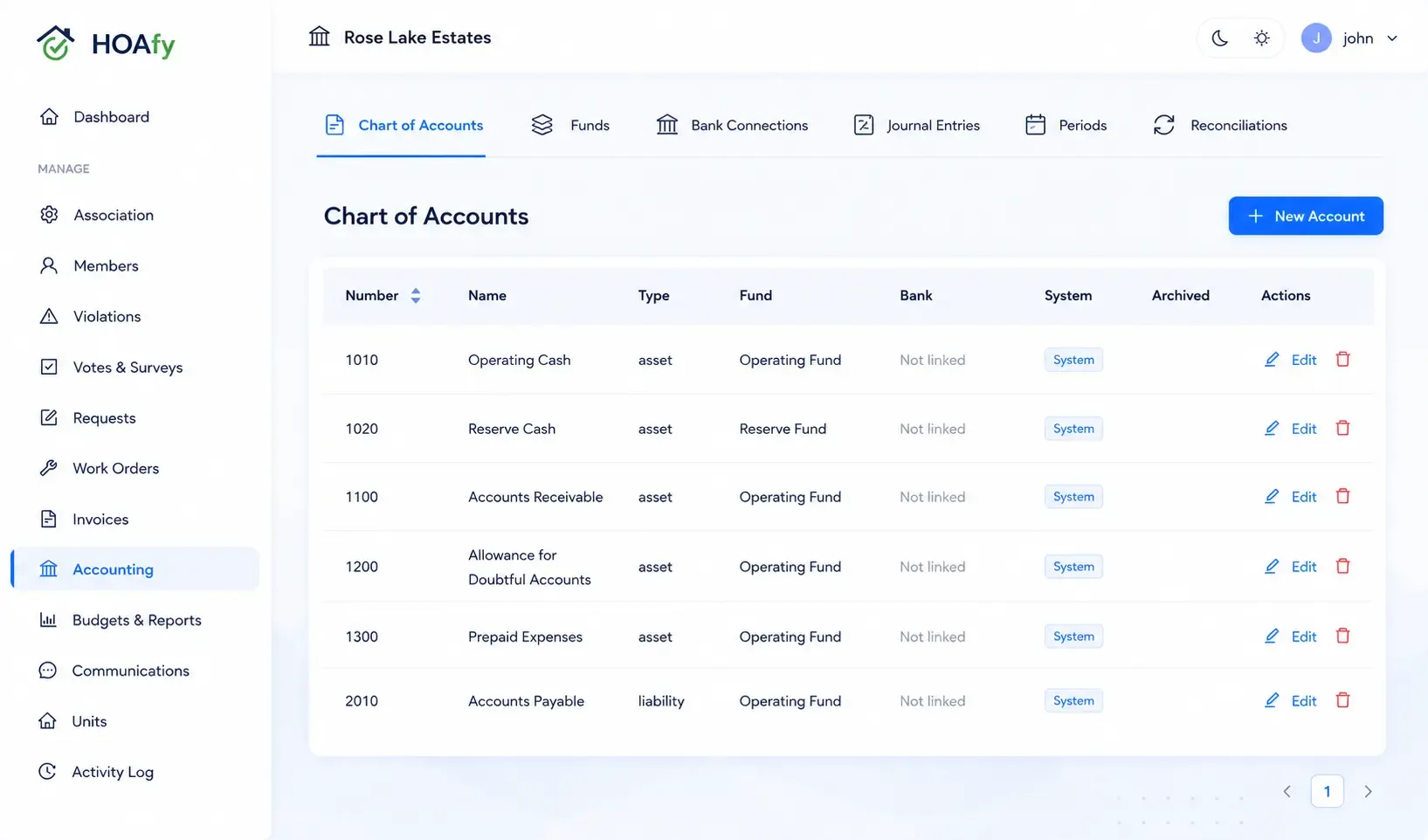
The chart of accounts is the organized list of categories in the general ledger. It should be detailed enough to support decisions but stable enough for year-over-year comparisons.
A practical structure includes:
| Account type | Common HOA examples |
|---|---|
| Assets | Operating cash, reserve cash, Assessments Receivable, prepaid insurance |
| Liabilities | Accounts Payable, prepaid assessments, payroll liabilities, loans |
| Fund balance | Operating fund balance, reserve fund balance |
| Revenue | Regular assessments, special assessments, late fees, interest income |
| Expenses | Insurance, landscaping, utilities, repairs, management, legal, accounting |
Avoid one broad “maintenance” account if the board needs to compare landscaping, pool, elevator, roof, and plumbing costs. At the same time, do not create a new account for every vendor or one-time purchase. Vendors belong in vendor records; the chart should describe the financial purpose.
Keep account names and numbers consistent. Archive an unused account instead of reusing its number for an unrelated purpose.
4. Separate Operating and Reserve Activity
Operating money pays recurring expenses such as insurance, utilities, landscaping, and management. Reserve money is set aside for predictable major repair and replacement projects such as roofs, paving, elevators, and pool equipment.
The board should be able to distinguish the two in both bank records and financial reports. A transfer to reserves is not ordinary revenue to the association, and spending reserve cash is not evidence that routine operations ran over budget. Fund accounting preserves those distinctions.
At minimum:
- Maintain board-approved fund and bank-account mappings.
- Record reserve contributions on schedule.
- Authorize reserve expenditures under the governing documents and applicable law.
- Track each major project against the reserve study and approved contract.
- Never borrow from reserves casually to hide an operating shortfall.
A reserve study estimates the useful life and replacement cost of major components and provides a funding plan. Update assumptions annually and commission professional updates at the cadence required or recommended for the association.
5. Record Assessments, Payments, and Prepayments Correctly
Under accrual accounting, billing a $300 monthly assessment creates both revenue and a receivable:
| Account | Debit | Credit |
|---|---|---|
| Assessments Receivable | $300 | |
| Assessment Income | $300 |
When the owner pays, cash increases and the receivable is cleared:
| Account | Debit | Credit |
|---|---|---|
| Operating cash | $300 | |
| Assessments Receivable | $300 |
Money received for a future assessment is generally not current-period assessment income. It is commonly recorded as a liability such as Prepaid Assessments until the assessment is earned. This keeps current revenue from being overstated and gives the owner a traceable credit.
Post payments through a payment workflow rather than editing an owner balance. Use reversals for errors so the original transaction remains visible.
6. Manage Vendor Bills Before Paying Them
An approved invoice represents an obligation even if the check will be issued next month. Under accrual accounting, a $2,500 landscaping invoice is recorded when the service is received and the obligation can be measured:
| Account | Debit | Credit |
|---|---|---|
| Landscaping expense | $2,500 | |
| Accounts Payable | $2,500 |
Payment later clears the liability:
| Account | Debit | Credit |
|---|---|---|
| Accounts Payable | $2,500 | |
| Operating cash | $2,500 |
Do not debit landscaping a second time when the payment clears. Link the contract, work order, invoice, approval, and payment whenever possible. Follow the complete work-order-to-ledger process.
7. Build a Budget From Evidence
A credible HOA budget starts with the prior year's actual results, current contracts, expected inflation, insurance renewals, utility trends, collection experience, and the reserve funding plan. It does not start by copying last year's spreadsheet and adding an arbitrary percentage.
Use this sequence:
- Review at least 12 months of actual revenue and expenses.
- Explain material budget variances and nonrecurring items.
- Obtain current vendor and insurance estimates.
- Estimate assessment revenue using realistic collection assumptions.
- Include the reserve contribution as a planned obligation, not leftover cash.
- Model cash timing, especially for annual premiums and seasonal work.
- Set assessments sufficient to fund the adopted plan.
- Follow notice and adoption procedures in the governing documents and state law.
During the year, compare actual results with budget monthly. A variance is a prompt to investigate, not automatically a failure. Timing, seasonality, emergency repairs, and classification errors can all create variances.
8. Close and Reconcile Every Month
The monthly close turns transactions into reliable financial statements. Use the same checklist and deadline every month:
- Record all assessment charges, owner payments, deposits, refunds, and reversals.
- Enter approved vendor bills and other known liabilities.
- Confirm transfers between operating and reserve accounts.
- Review uncategorized and unusual transactions.
- Reconcile every bank and investment account to its statement.
- Compare owner receivable detail with the general-ledger control account.
- Compare the Accounts Payable detail with the balance sheet.
- Review budget variances and unexpected account balances.
- Make documented adjusting entries and obtain required approval.
- Lock or close the period after review.
Bank reconciliation must end at zero difference. It should explain outstanding checks, deposits in transit, bank fees, interest, and errors rather than forcing the ledger to match the bank. See the HOA bank reconciliation guide for a faster workflow.
9. Give the Board a Complete Monthly Financial Packet
A board packet should make the association's position, performance, cash, collections, and disbursements visible. A useful monthly package includes:
- Balance sheet, with operating and reserve balances identifiable
- Income statement with current-month and year-to-date budget comparisons
- Statement of cash flows or equivalent cash activity report
- Accounts-receivable aging and delinquency action report
- Accounts Payable aging
- Bank statements and completed reconciliations
- Check register or payment register
- General-ledger detail for unusual or material accounts
- Reserve activity and project status
Directors should receive the packet early enough to review it. Record questions, answers, corrections, and board acceptance in the meeting record without exposing private owner information unnecessarily.
Learn what each HOA financial report reveals and use a consistent review order each month.
10. Install Internal Controls That Work With Volunteers
Internal controls protect the association and the volunteers handling its money. A small board may not achieve perfect separation of duties, but it can prevent one person from initiating, approving, paying, recording, and reconciling the same transaction.
Use practical controls such as:
- Two approvals for payments above a board-set threshold
- Read-only bank access for an independent reviewer
- Monthly bank statements delivered directly to more than one director
- Invoice approval supported by a contract or evidence of completed work
- No checks payable to cash and no blank signed checks
- Individual logins with multi-factor authentication instead of shared credentials
- Vendor change verification using a known phone number before updating payment instructions
- Independent review of bank reconciliations and payment registers
- Documented permissions and prompt access removal when officers change
- Fidelity or crime coverage appropriate to the association's risk
Board approval after money has already left the account is not a preventive control. Design the workflow so required approval occurs before release.
11. Handle Delinquencies Consistently and Privately
Assessments are the association's primary operating revenue. The board should adopt a written collection policy consistent with its documents and applicable law, then apply it consistently.
Review receivables by age, not only by total. A balance in the 90-plus-day bucket carries different risk from a charge due last week. Reconcile owner ledgers before sending notices, preserve payment-plan approvals, and involve qualified counsel before liens, foreclosure, bankruptcy action, or other legal remedies.
Discuss collection strategy in the proper setting and limit access to owners' financial details. A transparent policy does not require public discussion of a neighbor's account.
12. Prepare for Year-End, Taxes, and Independent Review
Before year-end reporting:
- Complete all bank reconciliations.
- Confirm receivable, payable, prepaid, loan, and reserve balances.
- Review open contracts and unrecorded liabilities.
- Document major repairs and capital projects.
- Preserve invoices, approvals, bank statements, tax forms, and meeting actions.
- Ask the CPA for a year-end request list before records are archived.
An HOA may receive a compilation, review, or audit depending on governing documents, state law, lender requirements, risk, and board policy. A compilation presents financial information without providing assurance. A review provides limited assurance through inquiries and analytical procedures. An audit provides the highest level of assurance and includes more extensive testing. Confirm the engagement type and required professional credentials with the association's CPA.
HOAs generally have federal tax filing obligations even if organized as nonprofit corporations under state law. The IRS explains that eligible associations may elect to file Form 1120-H separately for each tax year, while another applicable return may produce a different result. Have an HOA-experienced tax professional evaluate eligibility, taxable non-exempt-function income, filing deadlines, state returns, and the choice of federal form each year.
A Simple HOA Accounting Calendar
| Frequency | Board accounting task |
|---|---|
| Weekly | Review cash position, payment exceptions, and urgent collection or fraud alerts |
| Monthly | Close books, reconcile accounts, review the financial packet, approve corrections |
| Quarterly | Update forecast, review reserve projects, inspect controls and access permissions |
| Annually | Adopt budget, update reserve assumptions, renew insurance, file taxes, complete required CPA engagement |
| At every officer transition | Change bank authority, remove system access, transfer records, review unresolved items |
Common HOA Accounting Mistakes
- Treating the bank balance as available operating cash
- Mixing reserve and operating activity
- Recording a vendor expense both when billed and when paid
- Counting future assessments as current income
- Letting unreconciled months accumulate
- Comparing a cash-basis actual report with an accrual-basis budget
- Making undocumented journal entries to “plug” a difference
- Giving one volunteer control over billing, payments, disbursements, and reconciliation
- Assuming nonprofit incorporation means no tax return is required
- Receiving reports without documenting board review
Each mistake is preventable with a defined policy, a repeatable close, and a second set of eyes.
FAQ: HOA Accounting for Board Members
Does an HOA board member need to be an accountant?
No. Directors need enough financial literacy to understand the association's reports, ask questions, approve policy, and verify that qualified people perform technical work. The board remains responsible for oversight when bookkeeping is outsourced.
What accounting method is best for an HOA?
Accrual accounting usually provides the most complete financial picture because it reports earned assessments, unpaid owner balances, prepaid assessments, and incurred vendor obligations. The association should confirm state, governing-document, tax, and CPA requirements before adopting or changing a method.
How often should an HOA reconcile bank accounts?
Monthly is the minimum practical cadence for financial reporting. High-volume associations may review imported bank activity more often, but each statement period should end with a completed, independently reviewed reconciliation.
Should reserve funds have a separate bank account?
Separate bank or investment accounts make custody and reconciliation clearer and may be required by law or governing documents. Separate accounts do not replace fund accounting in the general ledger; the records must also identify reserve activity correctly.
What should a new HOA treasurer do first?
Obtain current bank access, governing documents, the adopted budget, latest reserve study, prior financial statements and tax returns, open receivable and payable lists, reconciliations, contracts, insurance policies, and the chart of accounts. Verify cash directly with the financial institutions and document unresolved differences.
Strong HOA accounting is a governance routine, not a year-end rescue project. Build the routine around traceable transactions, reconciled cash, complete statements, and documented board review.
Explore HOAfy financial management to connect assessments, payments, vendor bills, funds, reconciliation, and board reporting in one audit trail.