

Team HOAfy
Why the Letter Matters More Than the Rule
A violation notice does three jobs at once. It tells someone what's wrong. It creates the record that proves you told them. And it sets the tone for everything that follows.
Most boards focus on the first job and accidentally sabotage the other two. They write the letter fresh each time, in whatever mood they're in, and end up with a file full of notices that read like they came from five different organisations — because they did.
Here are three letters that cover almost everything, plus what each one has to contain.
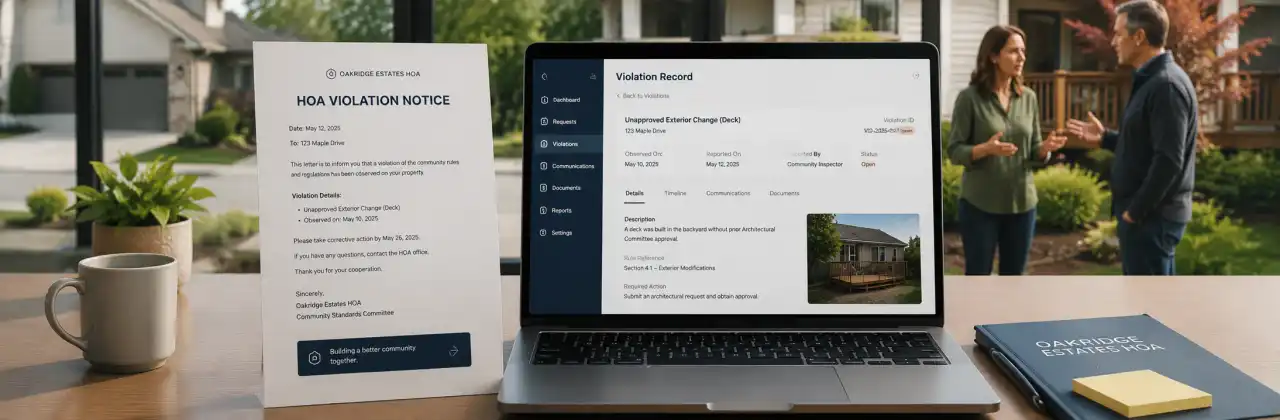
The Five Elements Every Notice Needs
Before the templates, the checklist. A notice that survives a challenge always contains:
- The date of observation — when the condition was seen, not when the letter was typed.
- The specific provision — article and section from your CC&Rs or rules. Not "the landscaping rules."
- A factual description — what exists, in neutral language. "A six-foot wooden fence along the west boundary," not "an eyesore."
- A cure deadline — an actual date, not "promptly" or "within a reasonable time."
- What happens next — the specific consequence, and the owner's right to respond or be heard.
Miss any of these and the notice becomes arguable. Include all five and most disputes end at the first letter.
Letter 1: Courtesy Notice
Use this first, nearly always. It assumes the owner doesn't know, which is true far more often than boards expect.
Subject: Courtesy notice — [rule topic] at [address]
Dear [Owner name],
During a routine inspection on [date of observation], we noticed [factual description of the condition] at [property address].
Section [X.X] of the [community] [CC&Rs / Rules and Regulations] provides that [quote or paraphrase the provision briefly].
This is a courtesy notice, not a fine. We'd appreciate it if you could [specific corrective action] by [date, at least 14 days out]. If the situation has already been resolved, or if there's something we're not aware of, please reply to this letter or email [association email] and we'll update our records.
Thank you for helping keep [community name] a place we all enjoy living in.
Sincerely, [Name], [Title] [Community name] Board of Directors
Why it's worded this way. "During a routine inspection" avoids implying a neighbour reported them, which is where feuds start. "This is a courtesy notice, not a fine" lowers the temperature immediately. The invitation to reply catches the cases where the board is simply wrong — the approved variance nobody remembered, the contractor already booked.
Letter 2: Formal Notice
Use when a courtesy notice has passed its deadline with no action and no contact.
Subject: Formal notice of violation — [rule topic] at [address]
Dear [Owner name],
On [date of courtesy notice] we sent a courtesy notice regarding [factual description] at [property address]. As of [date of re-inspection], this matter remains unresolved.
This is a formal notice of violation of Section [X.X] of the [CC&Rs / Rules and Regulations], which provides that [provision].
Required action: [specific corrective action] Deadline: [date, at least 14 days out]
If this is not resolved by the deadline, the Board may [state the specific consequence — schedule a hearing, impose a fine of $X, etc.] in accordance with Section [X.X] of the governing documents.
You have the right to respond. If you dispute this notice, believe it was issued in error, or need additional time, please contact us in writing at [address/email] before [deadline]. We would much rather resolve this by conversation than by enforcement.
Sincerely, [Name], [Title] [Community name] Board of Directors
Why it's worded this way. It recites the history, which is what makes the file coherent later. It names one consequence rather than vaguely threatening several. And the offer to talk stays open — boards that keep that door open right up to the hearing have dramatically fewer hearings.
Letter 3: Hearing and Fine Notice
Use when the formal notice deadline has passed. This one is the most legally sensitive, so check it against your governing documents and state statute before adopting it.
Subject: Notice of hearing — [rule topic] at [address]
Dear [Owner name],
Despite a courtesy notice dated [date] and a formal notice dated [date], the following remains unresolved at [property address]: [factual description].
In accordance with Section [X.X] of the governing documents, the Board has scheduled a hearing:
Date: [date] Time: [time] Location: [location, or video conference details]
At the hearing you may appear in person, send a representative, or submit a written statement to [address/email] before [date]. You may present evidence and explain any circumstances you'd like the Board to consider.
If the Board finds a violation has occurred, it may impose [specific penalty, e.g. a fine of $X, or $X per day continuing]. Any decision will be provided to you in writing, along with information about your right to appeal.
If you resolve this matter before the hearing date, please notify us and the hearing will be cancelled.
Sincerely, [Name], [Title] [Community name] Board of Directors
Why it's worded this way. The right to be heard, described concretely, is the single most important defence against a fine being overturned. Note the final line: leaving a no-penalty exit available right up to the hearing resolves a surprising number of cases in the last week.
Five Wording Mistakes That Cause Problems
Adjectives instead of facts. "Unsightly," "excessive," "poorly maintained" are opinions. "Grass measured at approximately 14 inches" is a fact. Facts survive challenges.
Naming the complainant. Never. "A neighbour reported" is enough to start a feud that outlasts the violation by years.
Vague deadlines. "Promptly" is unenforceable. Use a date.
Threatening consequences you can't impose. If your documents don't authorise daily fines, don't mention daily fines. One unenforceable threat undermines every letter you've ever sent.
Sarcasm. Every letter is a document that may be read aloud by someone else's attorney. Write accordingly.
Send It So You Can Prove It
The best-drafted letter is worthless if you can't show it went out. Whatever method you use — email, first-class mail, certified mail where your documents require it — record the date sent, the method, and keep a copy of the exact letter, not just the template.
This is where merge-based systems earn their keep: the letter is generated from the owner and property record, the send is logged automatically against the violation case, and a year later the full sequence is one click away instead of an archaeology project across three inboxes.
Frequently Asked Questions
Do we have to send a courtesy notice first? Usually not required, but almost always wise. It resolves a large share of cases at near-zero cost and demonstrates good faith if things escalate.
Can we email violation notices? For courtesy notices, generally yes. For formal notices and hearings, check your governing documents and state law — some require mail, and some require certified mail specifically.
What if the owner doesn't live at the property? Send to the address of record for the owner, not the property. Keeping owner mailing addresses current is unglamorous and matters enormously here.
Should the letter be signed by an individual or the board? The board, with a named signer. It's a board action, and individual signatures invite owners to treat it as one person's crusade.
How long should we keep sent notices? Indefinitely, attached to the property rather than the owner. The next board will need them, and so will the buyer's attorney.
The Point
Three letters. Write them once, have them reviewed once, and then use them without variation. The consistency is the product — not the prose.
For more on the record behind the letter, see HOA violation tracking: what your system needs, or look at how violations, notices, and owner records sit together in community management in HOAfy.