Team HOAfy
The Fence That Cost a Board Eleven Months
A homeowner in a 140-unit community put up a six-foot privacy fence. The CC&Rs capped fences at four feet. The board sent a letter. Nothing happened. They sent another. Nothing happened. Nine months later the board voted to fine, and the homeowner's attorney replied with a single question:
Can you produce the enforcement record for every fence in this community for the past three years?
They could not. There was a photo on a former board member's phone, and that board member had moved to Arizona. There was a letter someone was fairly sure had been mailed. There was a group text where two directors agreed the fence "looked fine, honestly." And there were, it turned out, four other fences over four feet that nobody had ever written up.
The fine was withdrawn. The fence stayed.
Nothing about that story is unusual. It is the ordinary result of tracking violations in the same place you track everything else: memory, email, and good intentions.
Watch violation management in the demo
A Violation Is a File, Not a Letter
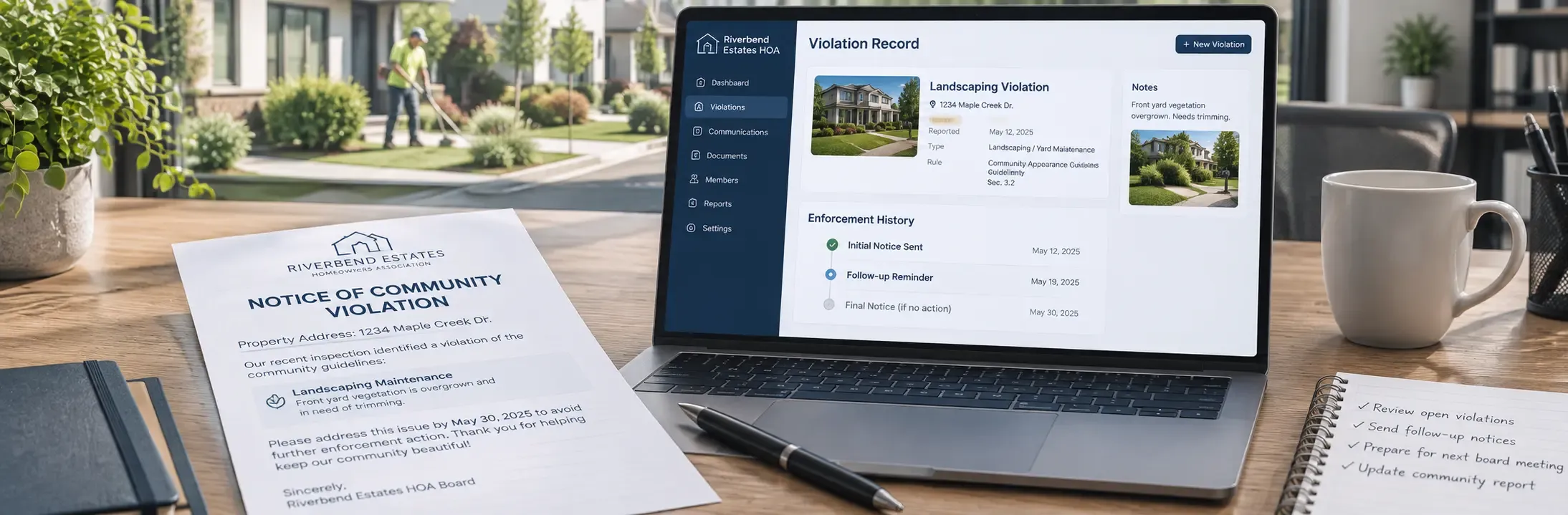
Most boards think of a violation as a letter you send. That is the visible part. What matters when someone pushes back is the record — the chain showing what happened, when, and whether this homeowner was treated the same as the last one.
A violation file that holds up contains six things:
- The observation. What was seen, at what address, on what date. Not "someone mentioned."
- Photographic evidence, dated, showing the condition clearly.
- The specific rule cited — article and section, not "the rules about fences."
- Every notice sent, with the date it went out and how.
- The homeowner's responses, including the phone call a director took in a driveway.
- The outcome — cured, fined, appealed, waived, escalated — and who decided.
Miss any one of those and you have a story rather than a record. Stories lose.
Why Spreadsheets Break Around Case Thirty
Plenty of self-managed boards start with a spreadsheet, and for a while it genuinely works. One tab, one row per violation, a column for date and one for status.
Then reality arrives:
- Photos live somewhere else — a phone, a shared drive, an email attachment. The spreadsheet has a column called "photo?" containing the word "yes."
- The treasurer resigns and the file history leaves with her.
- Nobody can answer "how many parking violations did we issue last year, and how many were cured within 30 days?" without an hour of scrolling.
- Two directors edit the same row on the same evening and one version quietly wins.
The spreadsheet does not fail loudly. It fails the day someone asks it a question it was never built to answer, usually in front of a lawyer.
HOA violation tracking software exists for an unglamorous reason: a violation is not a row, it is a case with a timeline, attachments, and participants. Tools built around cases handle that. Grids do not.
Five Questions Any Violation Tracker Should Answer in Ten Seconds
When evaluating an HOA violation tracker, skip the feature list and try to answer these:
1. What is open right now, and how old is each one? An aging view is the most useful screen a board has. Violations rarely get harder because they are serious. They get harder because they are old.
2. What has ever happened at this address? Full history per unit, including the previous owner. Buyers inherit many things, including arguments.
3. Have we enforced this rule consistently? Filter by rule type and look at every case. This is the question that ended the fence story, and it is the one that turns a dispute into a settlement.
4. What went out, and can we prove it? Notice date, delivery method, and a copy of the exact letter. "We definitely sent it" is not evidence.
5. What is due this week? Cure deadlines that pass unnoticed reset your credibility to zero.
If a system cannot answer those five, more features will not save it.
Templates Are the Unglamorous Superpower
The single biggest improvement most boards can make is not software at all. It is standardising the letters.
When each notice is written fresh by whichever director is annoyed that week, tone drifts. One letter is a friendly heads-up; the next reads like a subpoena. Homeowners compare notes. Inconsistent tone gets used as evidence of targeting, and occasionally it genuinely is.
Three templates cover roughly 90% of enforcement:
- Courtesy notice — friendly, specific, cites the rule, gives a date.
- Formal notice — same facts, firmer, states the consequence and the hearing right.
- Hearing and fine notice — dates, amounts, appeal process, all of it.
Write them once. Have them reviewed once. Then stop rewriting them at 11pm. Systems that merge owner and property details into a stored template give you consistency for free, which is exactly where consistency should come from: the process, not the mood.
Photos: More Than You Think, From Further Back
A close-up of a bin proves there is a bin. It does not prove the bin was at the curb on Wednesday, at that house, three days after collection.
Useful violation photos are:
- Wide first, close second. One frame establishing the property, one showing the detail.
- Dated automatically, not by someone typing a date in later.
- Repeated over time. The same angle at first notice and at follow-up tells the entire story in two images.
Boards consistently underestimate how much a second photo, taken 30 days later from the same spot, does to end an argument before it starts.
Give Homeowners a Window In
Most enforcement conflict is not about the rule. It is about surprise.
A homeowner who can log in and see an open violation, the photo, the rule cited, and the date they need to fix it by will usually just fix it. The people who escalate are disproportionately the ones who found out via a fine.
An HOA violations portal, even a simple one, changes the emotional shape of enforcement. It stops being something done to people and becomes something with a visible status and a clear exit. Boards that open this window generally report fewer hearings, not more. Transparency is a de-escalation tool.
A Reasonable Setup for a Self-Managed Board
If you are running HOA violation tracking for a self-managed community and want something workable this quarter:
- Pick your top five rules by actual complaint volume. Do not systematise all sixty.
- Write the three templates above and have them reviewed once.
- Agree a standard timeline — courtesy notice, 14 days, formal notice, 14 days, hearing — and apply it to everyone without exception.
- Log every case, including the ones resolved with a friendly conversation. Especially those. Unlogged leniency is what makes later enforcement look selective.
- Review open cases at every board meeting as a standing item, not an as-needed one.
That last point does more work than any tool. A five-minute standing agenda item turns violations into routine operations instead of occasional crises.
Frequently Asked Questions
How long should we give a homeowner to cure a violation? Whatever your governing documents say. If they are silent, pick a period and use it every time. Consistency matters more than the specific number. Fourteen to thirty days is typical for cosmetic issues.
Do we have to log a violation if the homeowner fixes it immediately? You do not have to. You should. A cured case is your best evidence of even-handed enforcement and it costs thirty seconds to record.
Can we fine without a hearing? In most states, no, and nearly everywhere it is a bad idea regardless. Fines imposed without a documented opportunity to be heard are the easiest thing in the world to overturn.
What about anonymous complaints from neighbours? Treat them as a prompt to inspect, never as the evidence itself. The record should show what a board member or manager observed, not what someone reported.
Is violation software overkill for a small HOA? Under roughly thirty units with few disputes, a disciplined folder structure can work. The real threshold is not size, it is turnover. The moment your board changes composition, institutional memory walks out the door and only a system keeps the history.
The Real Point
Almost every board that gets into trouble got there by enforcing inconsistently, not by enforcing too much or too little.
A tracking system is really a consistency machine. It makes the boring path — same rule, same timeline, same letter, every time — the easiest path to follow. That is the whole trick.
If you want to see how this works alongside dues, documents, and owner records in one place, have a look at community management in HOAfy.